
UPDATES & NEWS
Guest Blog: The Future of International Aid and Development: Lessons at the Intersection of Scholarship and Practice
A Graduate Seminar Blog from the International Education Policy Program, University of Maryland
By: Flory Abiwawanti, Anna Grigovera, Makynzie Horvath, Shamaim Kirmani, Anastasia Lavrenyuk, Namit Shrivastav, Christine (Chris) Smithson
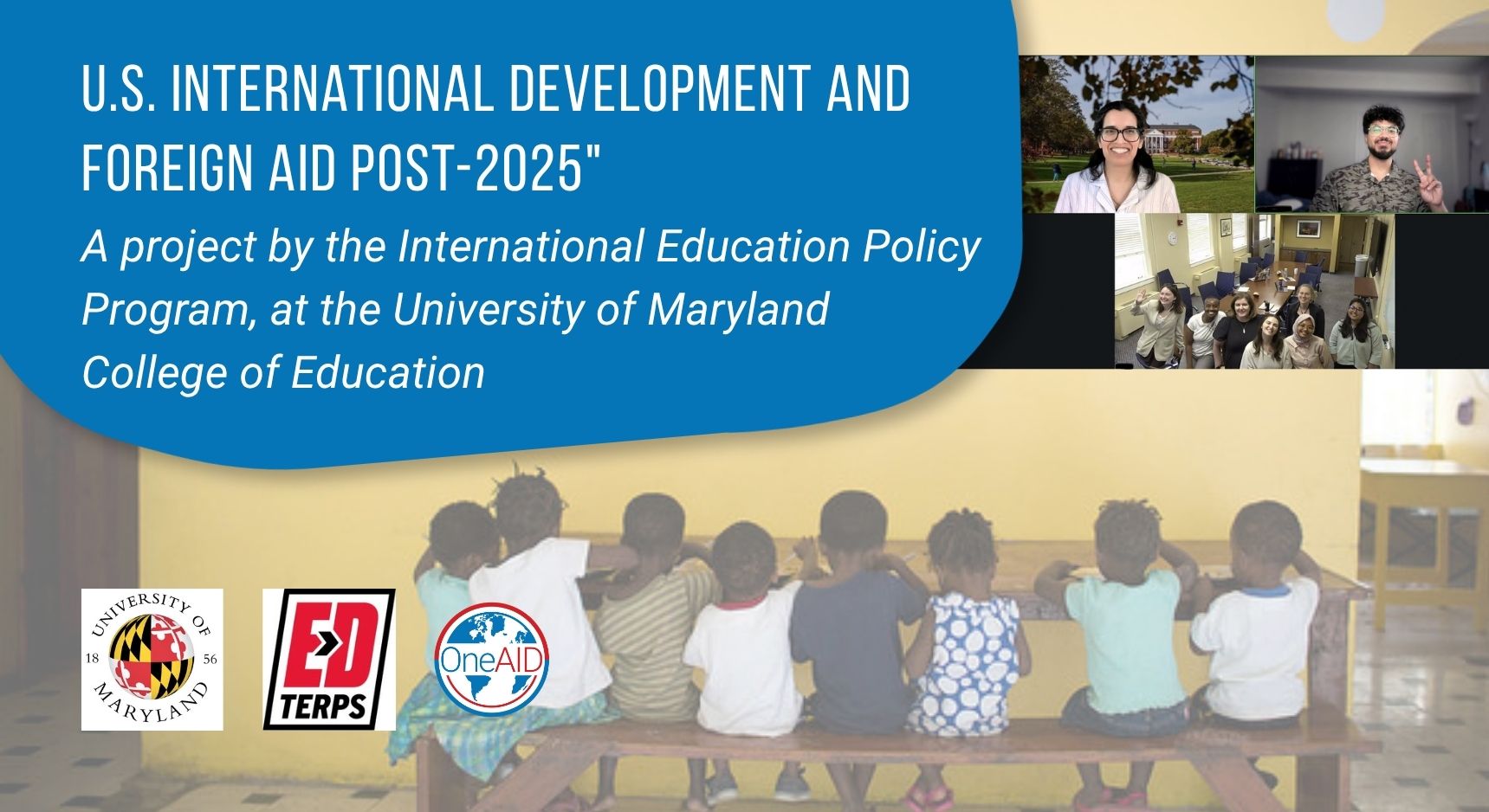
This blog was developed as part of a graduate seminar, “U.S. International Development and Foreign Aid Post-2025,” offered through the International Education Policy Program in the College of Education at the University of Maryland, College Park. The seminar brought together master’s and doctoral students with a shared interest in international development and education policy. Posts on this blog reflect student perspectives at the intersection of scholarship and practice, exploring what the future of international aid and development may look like in a rapidly shifting global landscape.
OneAID is pleased to partner with this class from the University of Maryland’s International Education Policy Program, sharing this work through our platforms as part of our broader commitment to connecting scholarship with practice in international development.
Introduction
In early 2025, the field of international aid and development faced an unprecedented shift with the abrupt closure of the U.S. Agency for International Development (USAID) under the Trump administration. Today, roughly 80% of USAID programs have been cut, with the remaining initiatives reallocated to the U.S. Department of State. Deep and lasting learning gaps formed as educational programs around the globe were slashed from 165 to 2 initiatives (J. Olszewski, personal communication, April 1, 2026). Formerly a major actor in the industry, the agency left a massive void; this closure has not only greatly reduced the U.S. presence in the field but, more importantly, has stripped away critical aid to communities across the world and displaced thousands of U.S. citizens and host-country nationals from their jobs (Faguy, 2025). Reports have documented that countries on the African continent have suffered the most severe impact, with funding reduced by 71 percent (Kenny & Sandefur, 2025). Research has also shown that the first casualties of the closures were project personnel, both in D.C. and around the globe, whose positions were completely terminated (Silver, 2025).
As international education and development professionals and graduate students of the International Education Policy program at the University of Maryland, we have been examining this dismantlement and studying its impact on a landscape that is important to our work. To this scholarship, we bring our positionalities as doctoral and master’s students who come from diverse backgrounds and experiences in Indonesia, Pakistan, Russia, Jamaica, India, and the United States. Together, we entered into conversation with former USAID workers: Josh Josa (former Management and Program Strategist for USAID’s Office of Diversity, Equity, and Inclusion), George Khisa (former Regional Coordinator for USAID East Africa), and Anna Roberts (former Acting Program Division Lead for USAID’s Center for Education), as well as USAID advocate Representative John (Johnny O) Olszewski of Maryland’s 2nd District, to reflect upon the evolving global role of the United States.
Introducing our Co-hosts and USAID Contributions
In their various roles, Josh, George, and Anna highlighted the scope of USAID’s influence across the world. Working in USAID’s Office of Diversity, Equity, and Inclusion (DEIA), Josh advocated for more disability, and LGBTQIA+, inclusive services to partner communities. As a Kenyan national, George worked with U.S. counterparts to support HIV prevention initiatives and promote youth leadership through the Young African Leaders Initiative (YALI). In her role within the Center for Education, Anna was a leading actor in creating a cohesive strategy on international education between USAID and other U.S. state partners through the READ (Reinforcing Education and Accountability in Development) Act, which functions as a comprehensive strategy to promote basic education globally (Basic Education Coalition, 2024).
As Congressman Olszewski notes in his interview, the stakes of these closures are enormous: “There are millions of children who have seen their learning interrupted. We are seeing gender gaps widening already. There are decades of progress that are at risk because of these decisions. Just a staggering number for me, is that there are 272 million children who are out of school. And that, I believe, is a number that will only keep rising as these global education funds dry up.”
USAID Dismantlement
Despite this impactful work, the dismantling of USAID has severely hindered the capacity of such programs to continue, leaving it to other state and private actors to meet these needs. Even more concerning was the abrupt nature of this closure. Reflecting on a specific project in Rwanda focused on deaf education, Josh notes that once the agency closed, “USAID headquarters just cut contact [with the Rwandan team]. No pay for their staff. Even to this day, their staff have not been paid,” a situation he pointed out occurred in several other countries as well. George further notes that due to the swift timeline of the closure, many projects could not be successfully transitioned to other local and international partners. Notably, Anna highlights that some programs have continued as a result of geopolitical priorities. For example, of the 55 countries where USAID implemented Basic Education programs, all were closed except for those in Jordan, a decision Anna attributes to Jordan being “a very politically important country for the U.S. government.”
The case of Jordan is revealing because it exemplifies that, in addition to providing critical resources and services to communities across the world, USAID was an important diplomatic tool for U.S. interests in the region. Since the dismantlement, the capacity for the U.S. to leverage humanitarianism for geopolitical purposes has greatly diminished, prompting a shift in U.S. credibility abroad. Yet, while it is not foreseen that USAID will return, nor that U.S. foreign assistance will reach its previous capacity, Representative Olszewski affirms a continuing advocacy for the U.S. commitment to international education. Reminiscing on the pivotal role education played in his life as a first-generation college student from a steel town, Representative Olszewski condemns these cuts to U.S. aid, commenting that “the elimination of those programs [has] created deep and lasting gaps [in] learning around the world” and that “there are decades of progress that are at risk because of these decisions.” He cites that approximately 272 million children are currently out of school and warns that this number will only rise as a result of these cuts.
Critical Perspectives
In part due to advocacy from Representative Olszewski and former USAID affiliates like Anna, Josh, and George, Congress did approve funding for international education for the coming fiscal year. However, in our conversation with Representative Olszewski, he shares that while “Congress did reaffirm a bipartisan commitment to international basic education, [they] had to fight very hard for a 25% top-line cut to education programs in fiscal year 2026.” He further explains, “[He] would not necessarily call this a victory because we have this money in place, and we staved off a complete elimination of the funding, but we also don’t have the programs to actually push that money into.” Consequently, at this point, the distribution of funds remains uncertain and limited. While the dismantlement of USAID disrupted the status quo of global humanitarianism, this shift has provided an opportunity to critically examine the systems of power that underpin the industry.
USAID’s recent fallout is situated in a broader development framework that unequally positions some countries as donors and others as recipients in an ongoing cycle of dependency. Looking at development as a historical construct rather than a normative solution is not a new tension. The apparatus of foreign aid is built upon historical constructions dating back to the post-WWII era, when President Truman’s 1949 inaugural address created the categories of “developed” and “underdeveloped,” positioning Western nations as the leaders of progress (Sachs, 1992; Escobar, 2012). Traditional state-led aid has also often functioned as a soft-power mechanism by channeling resources through technocratic, donor-driven frameworks that can erode the capacity of local communities to determine their own pathways to wellness and flourishing (Sachs, 1992). It can be debated whether USAID prioritized the interests of the U.S. over the communities it served; however, our affiliated colleagues highlight that the reality is much more nuanced.
Although USAID funding was determined through congressional approval, our colleagues emphasize that their programs were designed in partnership with multiple stakeholders. Anna discusses how her team primarily worked directly with ministries of education, recalling, “Our goal with education was to strengthen the systems of that country and to design our programs in partnership with them.” In his work, George mentions how colleagues at USAID headquarters would consult him for local input, noting that “they were keen to know how much engagement had been done with local stakeholders, beginning with government, communities, and the private sector, so all those were inputs.” Additionally, when reminiscing about his work in Rwanda on deaf education, Josh explains, “We worked with the different stakeholders within the country, including disabled people’s organizations… having their input and taking all of that into the design process.” Despite these commitments to local partnerships, it was clear that, even in USAID circles, many acknowledged the imperfections of their work.
In response to criticisms about USAID, Anna comments, “It’s really challenging, because no system is perfect. If you had asked pretty much anybody at USAID, ‘Is this a perfect system?’ everybody would have said no. We all had ideas on how to strengthen it or how to improve it.” She continues by noting that the swift dismantlement not only prohibited the opportunity to better these systems, but also meant that transitions to more local ownership could not be made sustainably, as many people were abruptly left without essential aid. Reflecting on his work with disability and LGBTQIA+ communities, Josh also expresses concern that this closure placed marginalized groups at greater risk, as they did not hold the same power and privilege as other local stakeholders. During its full existence, USAID did provide a means to advocate for better representation.
Future of U.S. International Aid
The future of U.S. international aid is uncertain, but as long as we sustain these conversations, there is hope. As our colleagues acknowledged, USAID was an imperfect system, but it provided essential resources and services to communities across the world.
At the same time, we observe the entry of other state and private actors into former USAID spaces. China’s increasing role in development assistance and a broader shift from state-based aid toward corporate ventures mark a new chapter (Tanis, 2026). The rise of Silicon Valley’s influence in development, such as algorithm-driven EdTech platforms and private-sector disruption, risks replacing one form of dependency with unregulated corporate monopolies.
In addition, there continue to be opportunities for congressional funding designated to support international education. As we grapple with the fallout of this abrupt dismantlement, there is also an opportunity and a responsibility to reimagine what equitable international partnerships look like. This means centering locally driven approaches: supporting mother-tongue instruction in early childhood education rather than defaulting to dominant global languages; integrating educational access with broader material realities, such as geographic access to schools, clean water, and healthcare; and recognizing that no educational intervention is sustainable if designed in a technocratic vacuum, disconnected from the lived conditions of the communities it aims to serve.
Authors

Flory Abiwawanti is a native Indonesian who has worked in international educational development in Jakarta for over four years, collaborating with both governmental and non-governmental international donors. She specializes in teacher development, with a focus on early childhood education and supporting teachers in rural areas.

Anna Grigovera is originally from Moscow, Russia. Anna’s scholarly interests span internationalization, the politics of international student mobility, decolonization of education, contemplative and holistic approaches to education. She brings three years of experience in International Admissions, holds a Bachelor’s degree in Cultural Studies, a Master’s in Applied Cultural Sciences and in International Education Policy from University of Maryland.

Makynzie Horvath is originally from Ohio, USA and is a doctoral student of international/comparative education with research interests in environmental justice and decolonial-feminist pedagogies as it relates to youth empowerment and community-based learning. Professionally, she served as a Peace Corps Volunteer in the Kyrgyz Republic, taught English in South Korea, and is a graduate assistant for the Leadership and Community Service Learning department at the University of Maryland.

Shamaim Kirmani is originally from Karachi, Pakistan, and has worked in educational research and evaluation for over two years. Her research interests are in language policy, girls’ education, and parental involvement.

Anastasia Lavrenyuk is from Moscow, Russia. In her third year of PhD in International Education Policy, and previously did her master’s at University of Pennsylvania with a focus on international educational development. She worked with UNESCO Institute for Lifelong Learning in the developmental sector.

Namit Shrivastava is originally from India. He is a graduate student in Survey and Data Science at University of Maryland, College Park with a background in Civil Engineering and a minor in Data Science from BITS Pilani. His research interests focus on applying AI, data science, and statistical modeling to infrastructure, sustainability, and large-scale social and geospatial problems.
Christine (Chris) Smithson is originally from the island of Jamaica and is a career educator in the United States whose doctoral research interests surround education and development as it relates to vocational education, education for girls and schooling in conflict and emergencies primarily in Latin America and the Caribbean.
References
Basic Education Coalition. (2024, December 18th). BEC Applauds Passage of READ Act Reauthorization https://www.basiced.org/govt-relations-updates/2024/12/18/bec-applauds-passage-of-read-act-reauthorizationnbsp
Escobar, A. (2012). Encountering development: The making and unmaking of the Third World (2nd ed.). Princeton University Press. (Original work published 1995)
Faguy, A. (2025, July 2nd). USAID officially closes, attracting condemnation from Obama and Bush. BBC. https://www.bbc.com/news/articles/c307zq8ppj6o
Kenny, C., & Sandefur, J. (2025, March 14). The USAID cuts: Little sign of mercy for “life-saving” health programs. Center for Global Development. https://www.cgdev.org/blog/usaid-cuts-little-sign-mercy-life-saving-health-programs
Kent, L. (2026, February 4th). One year on from dismantling of USAID, study projects that global aid cuts could lead to 9.4 million deaths by 2030. CNN. https://www.cnn.com/2026/02/04/world/lancet-usaid-global-aid-cuts-intl
Sachs, W. (Ed.). (1992). The development dictionary: A guide to knowledge as power. Bloomsbury Academic.
Silver, R., Menashy, F., & Morley, A. (2025). “A Planet Shaker”: Educational impacts of USAID’s dismantling. AERA Open, 11(1), 1-18. https://doi.org/10.1177/23328584251401508
Tanis, F. (2026, February 24th). China and the U.S. alter foreign aid strategies. NPR https://www.npr.org/2026/02/24/nx-s1-5711346/china-trump-us-foreign-aid-withdrawal
Related Articles:

Guest Blog: The Solidarity Fund
UPDATES & NEWSBy: The Solidarity Fund TeamWhen workforce reductions at USAID left thousands of...

Career Support Webinars
UPDATES & NEWSOn October 8, FedSupport, in partnership with FedsForward and OneAID, hosted a...

RIF Support: Key Steps to Protect Yourself
UPDATES & NEWSReceiving a Reduction-In-Force (RIF) notice can be unsettling and stressful....