UPDATES & NEWS
Guest Blog: A Talk About USAID at My Local Public Library
How a single evening became a blueprint for talking to your own neighbors about what America lost.
By: Zaid Abuhouran
Zaid Abuhouran is a former U.S. diplomat who spent 11 years in public service, including seven as a Foreign Service Officer directing education programs in Pakistan and El Salvador. He was separated from USAID in the 2025 reduction in force and now serves as Chief of Staff at the Karam Foundation.
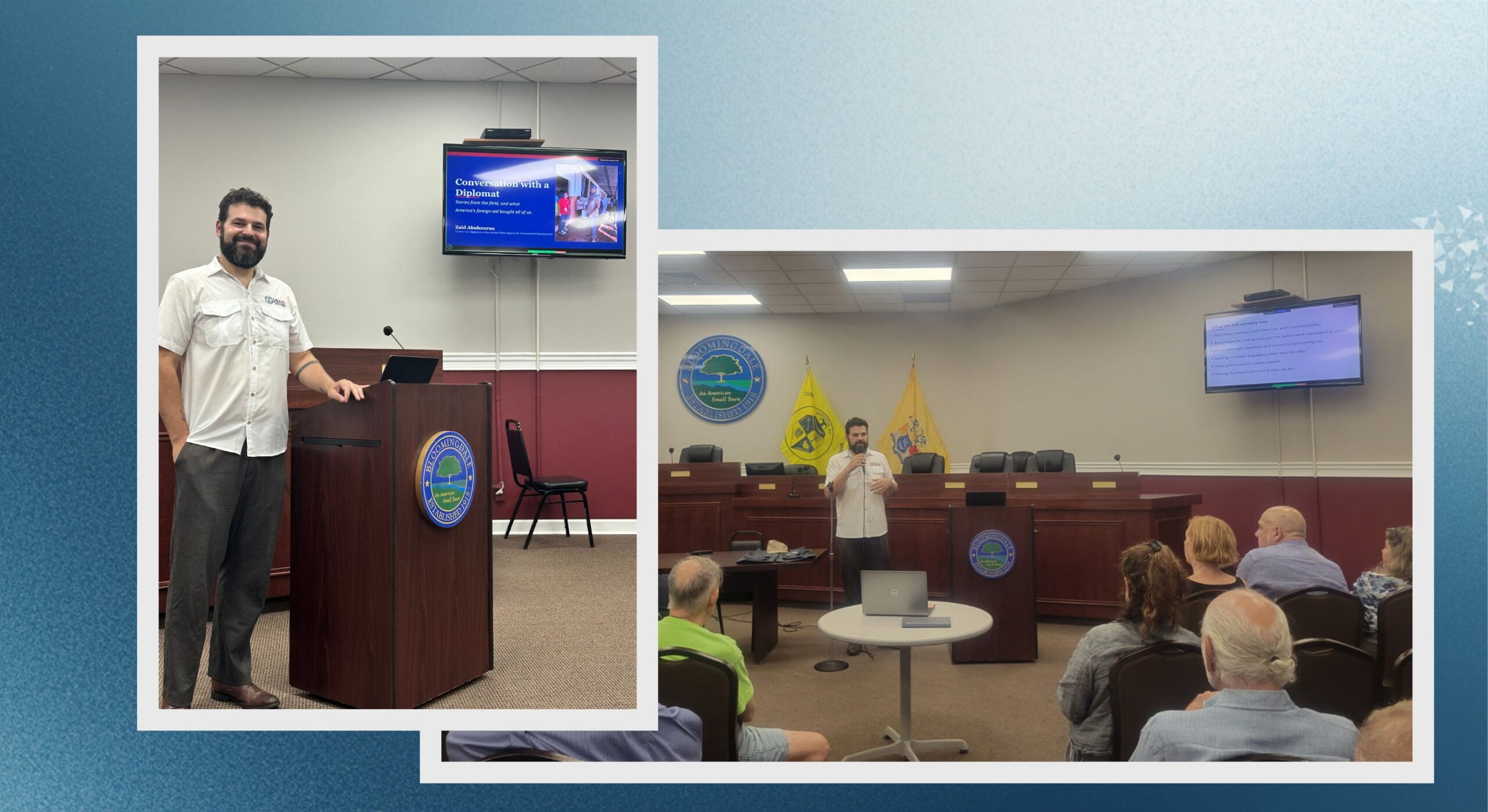
On July 14, about 30 of my neighbors came to the Bloomingdale Public Library in northern New Jersey to hear about a career most of them knew nothing about. For an hour I talked about what American foreign aid actually did, what it bought us, and what has been lost.
I planned it because the debate over USAID had drifted into abstraction, with people arguing about a share of the budget or conspiracy theories, while the actual work and the actual people dropped out of view. I spent my career on that work, and after my job and the agency were cut in 2025, it seemed to me that the most useful thing I could do was make it concrete for the people around me. Not in an op-ed aimed at Washington, but in a room full of folks I see regularly in my small community.
Getting the room turned out to be the easy part. I reached out to our public library and proposed a talk, and they said yes almost immediately, since they were marking their hundredth year and wanted local programming. They were the ones who gave it a name, “Conversation with a Diplomat.” My pitch was only a couple of sentences, essentially that a former diplomat who lives in town would like to talk about what foreign aid did and what happened to it, and I never had to put together a packet or a formal proposal.
If you want to do something similar, I would start with your public library, which is the easiest door to walk through. Look for the branch’s events page and email whoever handles adult or community programming, and if no name is listed, call and ask who books the author talks and lectures. Keep the ask short, telling them who you are, that you live in town, and that you would like to give a free, nonpartisan talk about your career in foreign aid and what has become of it. Offer a couple of possible dates, and ask them both to put it on their calendar and to send it to their mailing list, because that promotion will do more for your turnout than anything you post yourself.
The library is the easiest door, but it is far from the only one. Service clubs are always looking for speakers and tend to meet every week, so it is worth finding the local chapter of Rotary, Kiwanis, or Lions and emailing their program chair, whose whole job is filling those slots, though these talks usually run shorter, twenty or thirty minutes over lunch. The VFW and the American Legion are a natural fit as well, since this is fundamentally a story about service and about America’s standing in the world, and there I would write to the post commander or adjutant and lead with the strategic side of it. Houses of worship, senior centers, and local colleges host community talks too, as do the groups you may already belong to, whether that is a book club, a hiking group, a PTA, or a homeowners association, any of which comes with a room and a mailing list already attached.
A few small things make any of these easier. It helps to have a single clear paragraph describing your talk that you can paste into an email, and to say up front that you will keep it nonpartisan, which reassures a venue that might otherwise worry about controversy. Be flexible about length, since a fifteen-minute Rotary slot and a full hour at the library are both worth doing, and once one venue says yes, mention it to the next one, because a talk you have already given is a much easier sell than one that still only exists on paper.
The heart of the evening was the people. I put my own photos on the screen and told the room who was in them, the parents I had met, whole families, students walking across a stage at the end of a program we had funded. For each photo I told their story, who they were and what the program had meant for their lives and their futures, and why it mattered to their country. I also made the strategic case, because it is a real one. This work served the United States directly, and for many of the people in those photos an American aid worker was the only American they would ever meet, which made us the face of the country, and a good one. That kind of goodwill buys stability and security and influence, and it is not something you can rebuild with a check once it is gone. If I had one piece of advice, it would be to lead with the faces, let people meet the individuals, and keep the numbers in a supporting role.
From there I moved to the harder part. Foreign aid came to less than 1% of the federal budget, which for USAID worked out to roughly $36 a year per taxpayer, even though most Americans believe we spend closer to a quarter of the budget on it. I walked through what independent researchers and peer-reviewed journals now estimate the cuts will cost in lives, and I named each source out loud as I went (the Lancet, the Center for Global Development, Boston University, etc.) because doing so changes how the numbers land and protects you if someone pushes back later. I kept a slide of sources at the end and never had to show it.
I was also specific about how the cuts happened, since the speed of it is really the point. There was a freeze on day one with no warning, stop-work orders that halted programs mid-stream, medicine left sitting in warehouses, and no wind-down of any kind. Then I brought it home, to the tens of millions of dollars the cuts pulled from New Jersey institutions like Rutgers University and Johnson & Johnson, which was the moment the room stopped hearing about somewhere else.
I prepared for the skeptic too, and I would encourage anyone doing this to do the same rather than hope the hard question never comes. I had plain answers ready for whether there had been waste, why we should spend abroad when we have problems at home, and how we can know that anyone actually died. There was a fair debate to be had about reform, but what happened was not reform, and saying that calmly, without getting defensive, does more to hold a room than any statistic. It helped that I set the frame in the first minute, that this was about people I had known by name and not about a political party.
The response was more than I expected. People stayed to talk afterward, and neighbors have kept reaching out in the days since, a few of them beginning, on their own, to tell others to call their representatives. I never asked them to, though I did close by noting that funding gets decided in appropriations and that a call to your member of Congress is where it counts. People want somewhere to put what they are feeling, and it helps to give them one clear thing to do.
What stays with me is how low the barrier turned out to be. It took one email to a library, a set of photos and the people behind them, and a single evening. Thirty people is not a large number, but those thirty understand something now that they did not two weeks ago, and some of them are passing it on.
We were the face of America overseas for years, and for our own communities we are now the only ones who can do that. It does not take a stage, only a library, a few true stories, and the willingness to stand up and tell them.
Interested in finding a community closer to home? Join a OneAID group near you.
Need some insipration on how to host events? Check out these resources!
-
-
- Host a film screening or storytelling event
- Host your own Career Reset Bootcamp by visiting the Colorado Tuesday Group facilitator’s guide and summary report.
- Check out OneAID’s Community Programming Toolkit for facilitating get togethers and events
-
Related Articles:

Building OneAID: A Community for the Future of Foreign Assistance
Since February 2025, a dedicated group of USAID-affiliated women and volunteers have been working ti…

OneAid Community Launches New & Improved Website
We’re excited to announce that the OneAid Community website has a fresh new look and feel! Our redesig…

Town Hall on Community Care
OneAID is pleased to share the slides from the Community Care Town Hall with wellness support and car…