UPDATES & NEWS
One Year Later: Survey Documents Lasting Impacts of USAID's Dismantling on Workforce and Families
A presentation of findings and panel discussion at American University
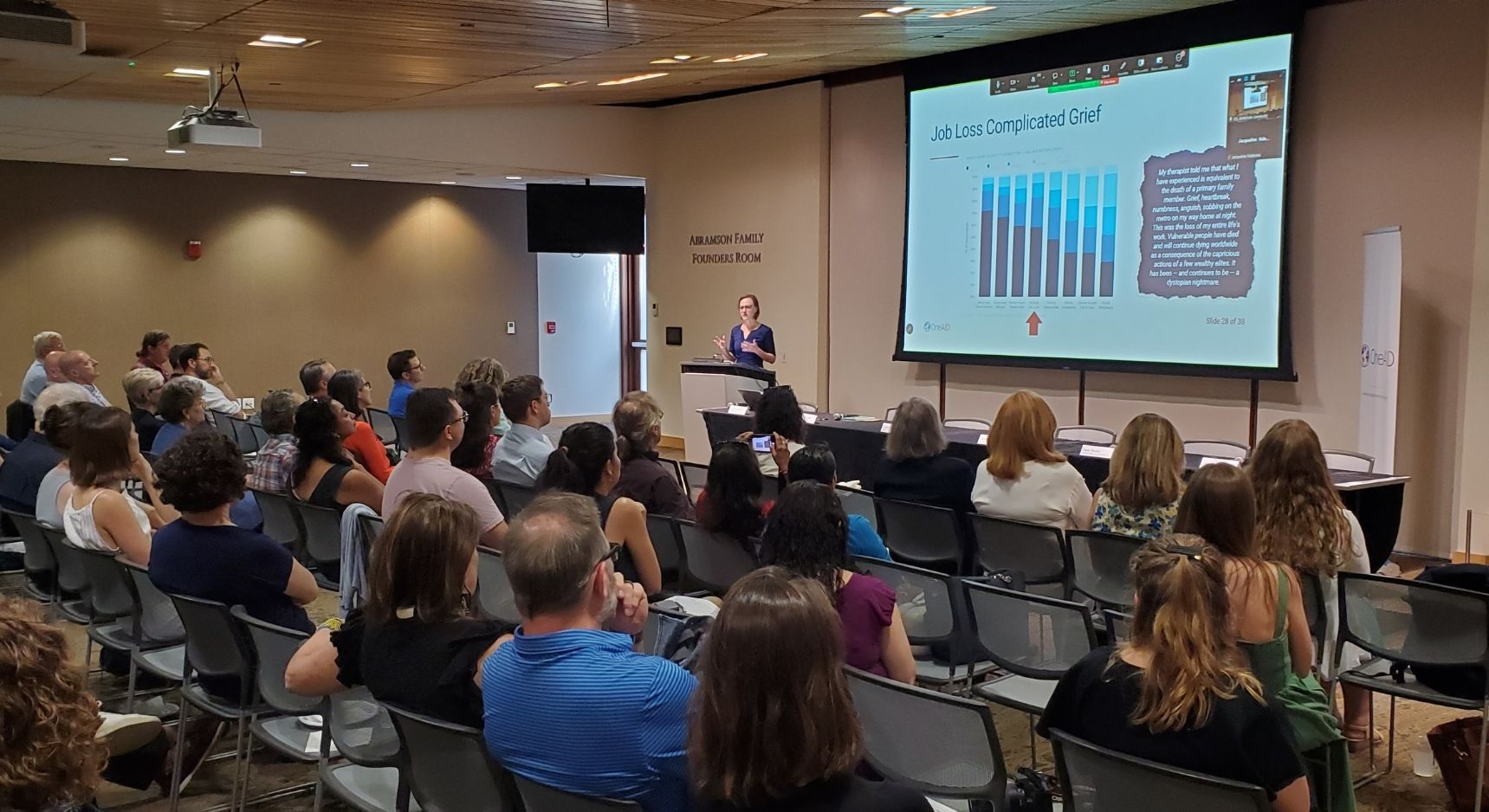
On June 11, OneAID hosted The Impacts of USAID’s Dismantling on its Workforce and Families: Survey Presentation and Panel Discussion at the American University School of International Service. Nearly 400 participants worldwide joined the event live via Zoom, while former USAID employees, contractors, implementing partners, students, researchers, and members of the broader foreign assistance community attended in person.
The event highlighted findings from a survey conducted by Jaime Oberlander, a former USAID Foreign Service Officer and current graduate student at the University of Michigan School of Social Work. Oberlander designed the survey to document how the dismantling of USAID affected the people who worked in and alongside the agency. Thanks to dissemination by OneAID and other foreign assistance partner organizations, the survey received 3,771 responses from participants across 49 states and 52 countries, making it one of the largest efforts to capture the experiences of the foreign assistance workforce.
Following Oberlander’s presentation, a panel examined the survey findings and discussed the state of the aid community one year later. The panel featured Catherine Baker, Managing Director for Strategic Partnerships and Communications at OneAID; Lynne Cripe, CEO of The KonTerra Group; Susan Reichle, Co-Founder of the Aid Transition Alliance and former USAID Counselor; and Anne Simmons-Benton, Board Deputy Chair of the Society for International Development United States (SID-US).
Drawing on their experiences in workforce wellness, community building, advocacy, and international development, panelists discussed the immediate and long-term effects of USAID’s dismantling on workers and families. They examined the professional disruption, emotional toll, and ongoing challenges facing thousands of members of the foreign assistance community.
For many attendees, the event provided something that had often been missing over the past year: data that reflected their own lived experiences.
Opening the program, OneAID Co-Founder and Managing Director for Community Programs Cate Klepacki reminded attendees that the survey represented real people behind the numbers. “The data we will examine reflects real losses of careers, financial security, a sense of purpose, and the people we left behind,” remarked Klepacki.
Throughout the evening, the survey findings reinforced that message.
A Community Eager to Share Its Experience
Oberlander explained that she launched the survey one year after receiving her own reduction-in-force notice. What began as a graduate research project quickly expanded into a broader effort to document the experiences of the aid community.
Thousands of people responded within four weeks. Participants included former USAID direct hires, contractors, implementing partner staff, and Foreign Service Nationals. The overwhelming response demonstrated the community’s desire to document what happened and understand its continuing effects.
“The response was overwhelming,” Oberlander said. “People wanted their stories to be heard.”
The survey examined employment outcomes, financial impacts, mental and physical health, family well-being, and coping strategies. Together, the responses revealed a workforce still facing significant challenges more than a year after the dismantling began.
Employment Recovery Remains a Challenge
Employment challenges emerged as one of the survey’s most significant findings.
Only 40% of respondents reported securing full-time employment, while an additional 4% reported full-time self-employment. Nearly one-third reported having no employment at all. Many others pieced together consulting assignments, temporary work, or part-time positions while searching for long-term opportunities.
The survey found that 43% of respondents continued actively seeking employment more than 15 months after the disruption began. Even among those who found new jobs, many continued searching for roles that better matched their experience, interests, or previous compensation levels.
For those who secured new positions, the financial impact remained substantial. Two-thirds reported taking pay cuts, and nearly half experienced salary reductions of 25% or more.
The data also revealed disparities among different groups. Employment levels generally declined with age, leaving many mid-career and senior professionals struggling to find opportunities that matched decades of specialized experience. African American respondents reported higher rates of unemployment and financial hardship.
Foreign Service Nationals faced particularly difficult circumstances. Oberlander noted that unemployment rates among respondents in host countries exceeded employment rates, often in locations where comparable opportunities remain limited and where previous affiliation with U.S. foreign assistance programs can create additional challenges.
The Personal Impact
While employment and financial losses dominated the discussion, the event also highlighted the profound personal impact reflected in the survey responses.
More than 80% of respondents reported stress-related physical health challenges, including sleep disturbances, headaches, gastrointestinal problems, and other symptoms associated with prolonged stress.
Mental health findings revealed similar concerns. Nearly eight in ten respondents met screening thresholds associated with anxiety, while more than two-thirds met thresholds associated with depression. Although these figures do not represent clinical diagnoses, they demonstrate widespread psychological distress among respondents.
Many participants also described a reduced sense of control over their lives. Nearly half reported continued struggles with uncertainty, diminished confidence, or difficulty making decisions about the future.
The panel also explored moral injury, a concept describing the distress people experience when events violate deeply held personal and professional values.
The survey found that 89% of respondents strongly or very strongly agreed that their values had been violated, while 83% reported feeling betrayed by trusted institutions.
Panelist Lynne Cripe of The KonTerra Group explained that the concept reflected what she had witnessed among members of the aid community.
“I think that’s one of the things that has been so painful for our community..that this is a community that sustained a very unique sort of trauma.”
Several panelists emphasized that many aid professionals did not simply lose jobs. They lost careers they expected to continue, professional networks they built over decades, and work that shaped their identities.
The Effects on Families
The survey also examined how the dismantling affected spouses, partners, and children.
Across all respondents, 20% reported that both adults in their household lost employment because of the dismantling. Among USAID Foreign Service Officers, that figure rose to nearly half.
The disruption also affected personal relationships. Eleven percent of respondents reported a change in relationship status during 2025, and nearly half of those individuals directly linked that change to the impacts of the dismantling.
Panelists spent significant time discussing the experiences of children and families, particularly those who had served overseas.
Approximately 80% of respondents reported that their children struggled following the disruption. Families described sudden relocations, interrupted schooling, separation from friends and support networks, and uncertainty about the future.
Several panelists noted that researchers have not yet fully examined the experiences of children and called for additional attention to this area.
Community and Resilience
The survey also explored how respondents navigated the past year. Participants most often cited family and friends as sources of support, followed by therapy, faith communities, exercise, volunteer work, and advocacy efforts.
Panelists echoed these themes during the discussion. They emphasized the importance of maintaining connections with former colleagues and finding ways to remain engaged despite significant professional and personal changes.
Organizations such as OneAID, Aid Transition Alliance, Aid on the Hill, the USAID Alumni Association, and countless informal networks have helped address gaps left behind by the dismantling. These communities have provided job leads, practical assistance, emotional support, and a sense of continuity during a period of profound disruption.
During the audience discussion, one participant shared a reflection that resonated throughout the room:
“It’s not necessarily where do we go from here, but how do we move on? Because we have to move on at a certain point.”
That question surfaced repeatedly throughout the evening.
Another participant asked the panel for how the community can continue advocacy and informing the American public about USAID’s work while balancing withering capacities for resilience and fight, as well as some members pivoting away from the sector.
OneAID’s Catherine Baker responded, “I think it is okay to take a break, and it is also okay to choose your battles.” She noted that more members of the community now feel empowered to share their experiences—both within their communities and publicly through media outlets. While the responsibility for USAID advocacy may require new voices to step forward, Baker encouraged attendees to pursue other avenues for civic engagement and service.
The survey documented significant financial hardship, widespread mental health challenges, and continued uncertainty about the future. It also captured a community working to understand what happened and determine what comes next.
Oberlander began the project as an effort to better understand the experiences of people affected by USAID’s dismantling. With nearly 3,800 responses, the survey has become one of the most comprehensive records to date of how those decisions affected workers and families across the foreign assistance community.
As panelists emphasized throughout the discussion, the numbers matter—but every percentage point represents a person, a family, and a career disrupted. The survey provides a clearer understanding of those experiences and creates a foundation for future research, advocacy, and support for a community that continues to navigate the consequences more than a year later.
Watch the recording of the event:
Resources & Support:
Join a Community Close to You
Join a local State, Regional, or Country group and connect with a community closer to you.
Mental and Emotional Wellbeing
Practical reflections and tools for coping, grounding, and sustaining yourself through challenging times.
Free Six-Session Monthly Support Series
OneAID, in partnership with Somatic Experiencing International, will host a support series focused on mind-body approaches to managing grief, anger, uncertainty, and stress. The series begins Monday, May 18, 2026 and runs through October 2026.
Related Articles:

Global Community Day
UPDATES & NEWSIn the heart of the nation's capital, a powerful message rang out: the global...

Building OneAID: A Community for the Future of Foreign Assistance
Since February 2025, a dedicated group of USAID-affiliated women and volunteers have been working ti…

OneAid Community Launches New & Improved Website
We’re excited to announce that the OneAid Community website has a fresh new look and feel! Our redesig…