UPDATES & NEWS
OneAID Co-Hosts Book Talk on Into the Wood Chipper
A candid conversation on institutional failure, public service, and accountability.
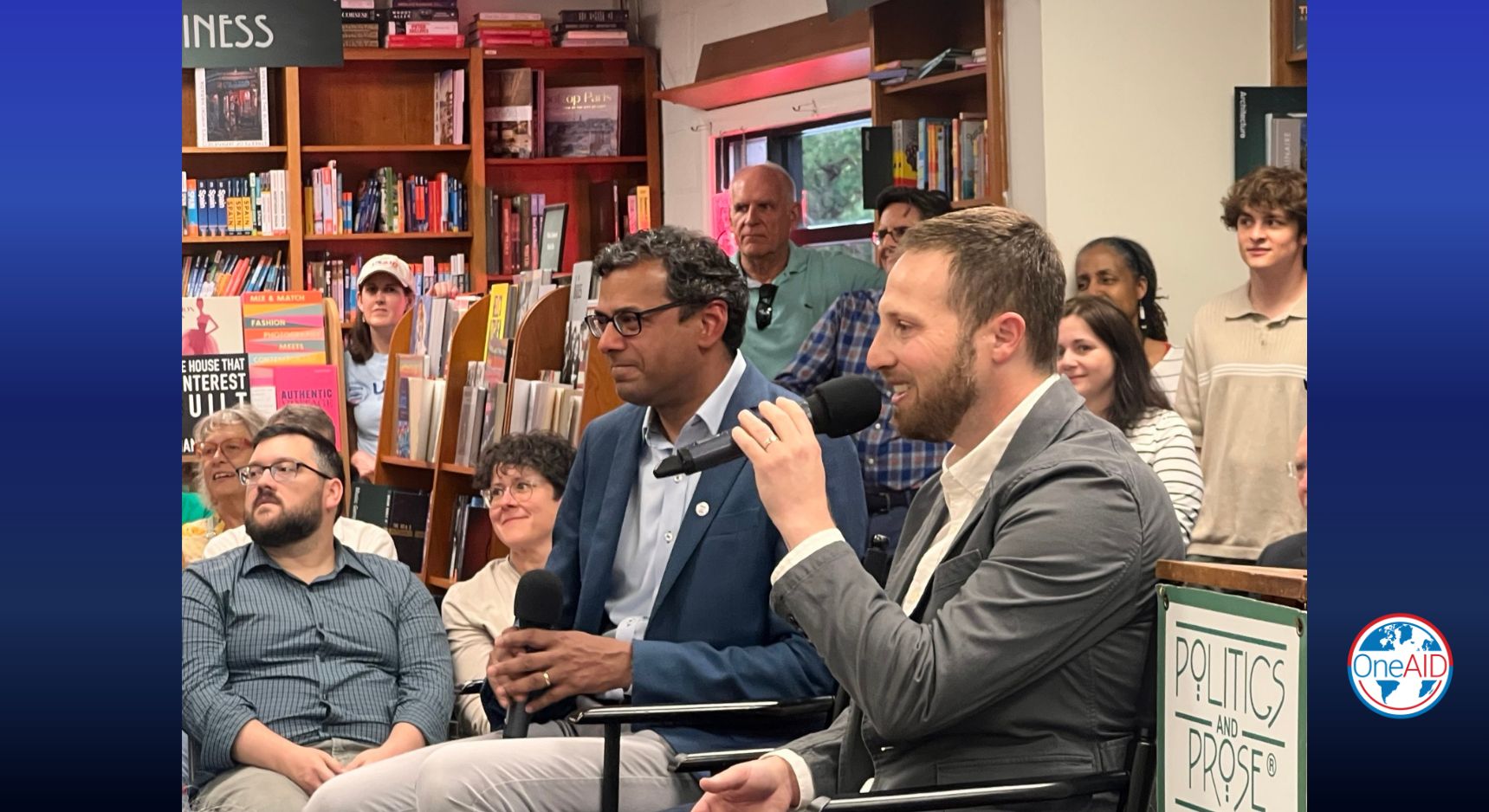
On the evening of April 15, 2026, over 300 people packed the Connecticut Avenue Politics and Prose Bookstore for a book talk with Nicholas Enrich on his book Into the Wood Chipper: A Whistleblower’s Account of How the Trump Administration Shredded USAID, moderated by Dr. Atul Gawande.
Overflow seating filled 45 minutes before the event began. The room was packed with former USAID staff, implementing partners, and their families – many who had lived through those early days of January 2025 firsthand.
It was difficult to collectively revisit that period, but the energy and attention in the room were unmistakable. People weren’t just there to listen, they came to engage with the experience and its implications.
Into the Wood Chipper is both a firsthand account of USAID’s dismantling and a broader reflection on what it means to take principled action in moments of institutional crisis. It captures not just the events themselves, but the internal reckoning faced by career public servants as systems they believed in unraveled around them.
Enrich’s story is especially significant as one of the first whistleblower accounts to emerge from this period. His decision to document, testify, and ultimately publish underscores the critical role whistleblowers play in ensuring these moments are not lost or rewritten.
During the discussion, Enrich emphasized a point that clearly resonated with the audience: “Do not wait for someone else to do it for you. You always think there is somebody else, somebody higher up, who knows more and is going to act…no. We all have our own agency, and we could all be the one.” In his book, he offers practical guidance for those still in government who may find themselves confronting similar decisions, urging documentation, courage, and a willingness to act even if it comes at a personal cost.
The conversation moved between personal narrative and systemic reflection. Enrich spoke candidly about the uncertainty leading up to January 2025, the speed and scale of the agency’s dismantling, and the moral tension faced by staff navigating impossible choices.
The discussion highlighted the abrupt halt of lifesaving programs and its global consequences, the internal debates among staff over whether to resist, comply, or document, and the moment it became clear that the goal was not reform, but elimination.
Throughout, the conversation balanced policy-level implications with deeply human experiences, what it meant to show up to work each day as the ground shifted beneath you. Enrich balanced the heavy subject matter with moments of humor, particularly as he recounted learning, via a mass agency email and texts from colleagues, that he had, overnight, become USAID’s top health official while he was on vacation.
The atmosphere was deeply reflective. Many attendees spoke about the difficulty and catharsis of revisiting those early days. One former colleague shared, “Though difficult to relive, I’m deeply appreciative to Nick for chronicling these events in his book. For the first time, I have a detailed record to share with others that reflects my experience witnessing USAID’s dismantling.”
The audience remained fully engaged throughout, responding with sustained applause and strong support for Enrich’s decision to speak out.
During the Q&A portion of the event, former USAID Administrator Gayle Smith took the microphone, offering reflections that connected past leadership to the present moment. To Enrich, she remarked, “Courage is a beautiful thing, and thank you for having that.” She also acknowledged those in the room and around the world who supported USAID’s mission: “They tried to kill USAID, but they didn’t kill it. The spirit, the commitment, the resilience is still here. And I hope all of you know, as hard as this moment is, I don’t think any of us [administrators] could accomplish what we did on behalf of a given administration without you.”
The Q&A underscored how much this moment is still being processed. Questions reflected both personal experience and broader concerns about accountability, institutional memory, and what comes next.
For those unable to attend in person, the event was livestreamed on Instagram, expanding the conversation beyond the room and allowing others to participate in real time. A recording was uploaded to OneAID’s YouTube channel the following day for broader access.
Related Articles:

RIF Support: Key Steps to Protect Yourself
UPDATES & NEWSReceiving a Reduction-In-Force (RIF) notice can be unsettling and stressful....

Job Searching? Finding the Right Culture Fit Matters
UPDATES & NEWSOneAID Community member Celena Westlund recently joined us on a panel to share...

Resources for Navigating the Government Shutdown
UPDATES & NEWSIn these challenging times, we stand united as a community, ready to support one...